Monday, November 16, 2015

Thursday, November 12, 2015
Heart Dissection Lab Questions
1. The purpose of the pericardium is to hold the heart in place, protect it, and stop it from literally exploding from the pressure.
2. Arteries have thicker walls than veins do.
3. The auricle is meant to expand, giving the atria more volume to hold blood.
4. The left ventricle looks and feels harder and slightly larger than the right.
5. a) The coronary sinus is a large vein on the posterior of the heart that collect blood from the coronary artery and sends it back to the right atrium.
b) The inferior vena cava brings the oxygen deprived blood from the lower body back to the heart.
c) The tricuspid valve, or Right Atrioventricular Valve separates the right atrium and ventricle to prevent back-flow.
6.
7. The "anchoring" of the valves in the heart by the chordate tendinae and the papillary muscles is important because it makes sure there is no back-flow of blood causing lack of blood floe to body or malfunctions in the heart.
8.
9. The semi lunar valves between the right and left ventricles and pulmonary artery and aorta respectively, is to prevent back-flow of blood back into the ventricles from the arteries.
10. a) If there is a malfunction in the right side of the heart and a swelling of the feet occurs, it means that blood isn't properly being taken from the lower extremities by the inferior vena cava into the right atrium and right ventricles. If there is back flow in this area, oxygen deprived blood is stuck in the body.
b) If there was a valve defect in the left side of the heart, the heart would not be properly transporting blood to the rest of the body and the body's cells would be starved of oxygen and die.
11.
 12. The right side of the heart receives oxygen deprived blood from the body and send it to the lungs to get oxygen. The left side of the heart receives the oxygen rich blood from the lungs and sends it to the rest of the body.
13.
2. Arteries have thicker walls than veins do.
3. The auricle is meant to expand, giving the atria more volume to hold blood.
4. The left ventricle looks and feels harder and slightly larger than the right.
5. a) The coronary sinus is a large vein on the posterior of the heart that collect blood from the coronary artery and sends it back to the right atrium.
b) The inferior vena cava brings the oxygen deprived blood from the lower body back to the heart.
c) The tricuspid valve, or Right Atrioventricular Valve separates the right atrium and ventricle to prevent back-flow.
6.
 |
| Right side of heart (tricuspid valve + chordae tendinae and papillary muscles) |
8.
 |
| Left side of heart |
10. a) If there is a malfunction in the right side of the heart and a swelling of the feet occurs, it means that blood isn't properly being taken from the lower extremities by the inferior vena cava into the right atrium and right ventricles. If there is back flow in this area, oxygen deprived blood is stuck in the body.
b) If there was a valve defect in the left side of the heart, the heart would not be properly transporting blood to the rest of the body and the body's cells would be starved of oxygen and die.
11.
13.
 |
| Cross Section of Heart |
Wednesday, November 11, 2015
Unit 3 Reflection
 |
| The heart my group drew in chalk. |
The keep a healthy circulatory system and also respiratory system because the oxygen our blood transports come from our lungs there are a few thing to keep in mind. As always, eating healthy and exercise are hugely beneficial for your system because it keeps your blood flowing nicely and helps prevent clots form forming in the blood stream. Another major thing is don't smoke! The nicotine in cigarettes are a vasoconstrictor making your heart work harder to transport blood around and also it hurts your lungs, a lot.
This unit I loved learning about the many different parts of the heart and their purposes. I find naming all the different structures in the heart fascinating and seeing how they connect. One thing I struggled with was the different types of blood cells and also keeping heart attacks and strokes straight. In many ways they are similar but they are very different and I kept confusing them. Dissecting the sheep heart was very informative because it showed that hearts are perfect like in drawings, they are actual 3D objects that aren't color coded. I am to, for the rest of the semester, to make sure I find the connections in how everything relates back to health because that is were I am struggling.
Monday, October 26, 2015
Healthy Snacks
We made very cute and healthy snacks for Alexandria's and Simrun's Monday Wellness. We learned about what makes a healthy snack too. You should snack 2-3 times a day a couple hours before a meal and should eat nutrient rich snacks, not empty snacks that are high calorie and sugar.You should definitely stay away from super sweet and sticky snacks like artificial granola bars. Making the little apple snacks was really fun and were very yummy. The only thing is the apple got stuck in my braces but that has nothing to do with the activity.
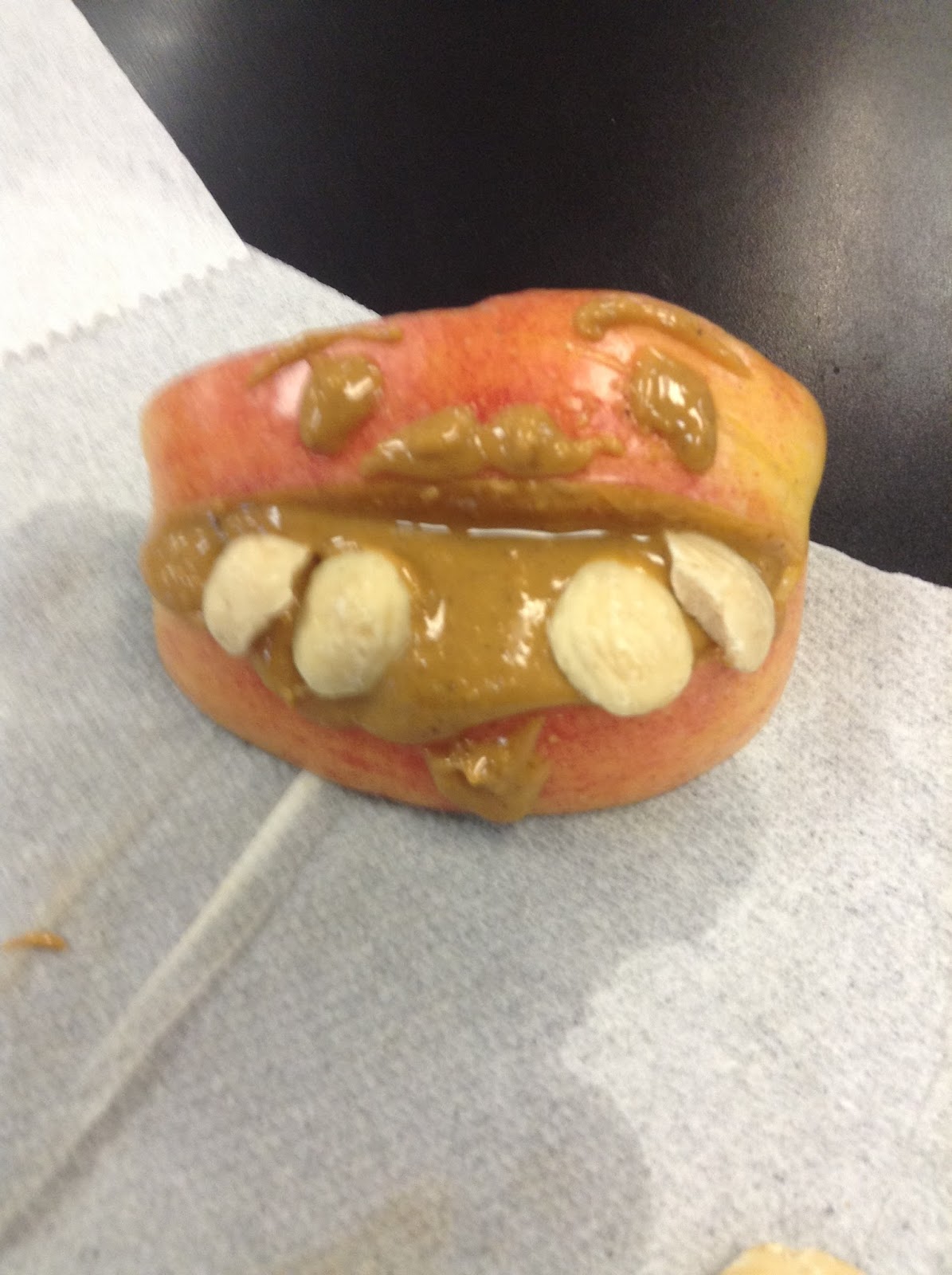 |
| His name is Reginald :) |
Wednesday, October 14, 2015
Have a Heart

The systole was the higher number and the diastole was the lower number because the systolic pressure is the pressure at which the blood can flow out of the blood pressure cuff and the diastolic pressure is when the blood returns to a normal flow. To measure blood pressure you use a sphygmomanometer or simply called a blood pressure cuff that includes a hand pump and a pressure gauge. To measure heart rate you can just use your fingers or you can use a stethoscope. If you are using your fingers it is best not to use your thumb because you can feel your pulse in your thumb and that would lead to confusing results. To use a sphygmomanometer you first have to put the cuff around the persons bicep a good two inches away from the elbow to allow enough room to place the stethoscope. With the cuff snug, but not too tight, you inflate it using the small hand pump, making sure the valve is closed. Once the pressure reads about 150 mmHg, you open the valve slightly to let out the air slowly (so the gauge drops about 3 mmHg per second) and listen carefully with the stethoscope. You should hear nothing for a little while but when you hear a whooshing sound pay attention to the number on the gauge and when the sound gets quiet again that is the other number.
Monday, October 12, 2015
Monday Wellness: Core Reflection
My partner, Amelia, and I did our presentation on the core muscles and core exercise and you can find our presentation here. This is a topic that applies to our lives very heavily because we are dancers in the color guard and have to focus on core strength and having good posture while performing. Core strengthening is very different than regular strengthening because it has a larger influence on daly life and everyday tasks unlike regular muscle building activities. The activity we did in class with everyone was also very fun because it was rather simple, but it showed people the many different muscles the more is made up of and how to work out the major ones. We used a Pilates manual to find our exercises, and because my mum is an advanced pilates instructor she showed me how to do each exercise, where it should hurt, and what to focus on, which proved to be very useful and informative. In dancing, you are constantly told to “stay lifted” and she doing turns or just balancing to “use your core” so I have always known that the core was more than the abs because you couldn't keep balance with just abs.
In doing all of this research I learned that the core actually affects the lungs as well as the abdominals, obliques, and back muscles. It was cool to see how diverse the core actually was and to read about all the exact muscles that made up the core. There were so many exact muscles though that we couldn't really include all of the in our presentation to the class so we mentioned a few while doing the exercises. The core makes up all the muscles that aren’t your arms and legs so it is a vital part of every activity. Its used in literally all other exercises because your body needs to hold itself still to isolate the other muscle trying to work, causing you core to be engaged. Having a stronger core makes daily life a little easier to go about and increases flexibility as well since the stronger core you have, the less stress is put on the limbs, giving them more freedom to move around.
If I had to grade us on this presentation on a scale of one to ten, I would give us about a nine. I would say nine rather than an eight or a ten because we tried our best to make the information somewhat entertaining and interesting rather than turning it into a lecture practically in latin because of the many scientific names for the muscles. I wouldn't give us the full ten because we definitely could have spent more time defining the exact muscles of the core and saying, in detail, what everything is doing during the exercises. To get above the eight though, I feel like we made the activity and working out not as boring as it could have been because we played music in the background, we demonstrated the exercises and we tried to be interactive rather than purely telling them what to do.
My mum, being a Pilates instructor, has brought me to many of her classes. From those classes I have worked muscles in the core I didn't even know I had, and after those work outs, I did considerably notice my color guard dancing getting better and I was more flexible while I consistently did Pilates. I found from doing those classes and doing research on this project that everything in the body connects to everything else. The breathing exercises we did not only warmed up the core, but also relaxed people because it was like incorporating meditation into a workout by focusing on breath.
Thursday, October 8, 2015
Unit 2 Reflection
Being healthy means that your body is at its prime level of performance. It means you get enough sleep each night; you don't eat too much food and its mostly plants; you aren't constantly stressed; you have good friends who are there when you need them; finally, you get the right amount of exercise for your body.
I would not say I am a very healthy person. I definitely don't get the recommended 9 hours of sleep a night as I found in my sleep analysis project, and you can tell from the time this was posted, I don't finish homework at a good time to get to bed early. I also don't eat very healthily. I also do not eat as much as I used to, but the food I eat isn't the most nutritious as I found from our food tracking activity. Probably the worst area for me is stress. I am honestly stressed most of my day and, because of my procrastination, most of my night while studying or finishing homework. Drinking coffee to stay awake doesn't help anything either. I stress about the little things that don't matter because my mind likes to think they do matter and have to be perfect even when they most definitely do not need to be. The two sections I don't completely fall behind in are social and exercise because I have found that I do have lots of friends who are always there for me when I need it or when they need me. I am extremely introverted so interaction with people exhausts me greatly, but my few close friends rarely make me feel worn out and I can recharge even when I am with them rather than being completely by myself. As for exercise, I like to think I get enough activity with the usual 13 hours of color guard practice a week, but I know I still should get more intense exercise done outside of those practices.

At Saratoga, I feel like we aren't healthy by these standards. As far as I can tell, most people don't eat the healthiest foods they serve in the cafeteria, definitely don't get enough sleep, and are far too stressed about grades. In regards to social I think the school is sufficient. Exercise though, I feel like the school has a wide range of people: those who play hours of sports every day, and those who sit at their computers all day and get no activity.
There are several things that they school could consider to try and improve a couple of these issues. Firstly, they could provide more, cheaper, healthy options in the cafeteria rather than the abundance of delicious but unhealthy snacks. The more important issues are stress and sleep. Both of these directly relate to grades and homework load since students will stress about getting a perfect grade on a test and stay up late studying for it or they will have so much homework that they can't get to sleep until late because they are constantly working. These could easily be reduced by less homework and less emphasis on getting perfect grades because grades only tell a small portion of who you are.
A few essential things taught in this unit were the science behind all the advice given to us about healthy eating and sleep. It taught me the limitations of just healthy eating or just exercising to get healthy or lose weight, because you cant just do one, you need to do both. I also had to make myself admit that I was getting way too little sleep and that it is not healthy for me to me tired everyday, all day.
If I am to be completely honest I didn't learn all that much from this unit because my mom is a fitness instructor, runs a weight loss program, and specialized in sleep psychology. About 80% of the material is stuff I have heard over and over again form my mom telling me to eat healthy, to get at least 30 minutes of activity a day, to sleep regularly to not mess us my circadian rhythm, try and not be stressed all the time and breath, etc. I did learn the exact science behind why each of those is important though and that I find is very valuable coming from someone who isn't my mother.
From this unit I learned what BMI means and, even though it is not a perfect way of determining health, how it can be useful in finding ways to be healthier. I learned in more detail the stages of sleep and how the brain waves look different in each type. One of the most interesting things I learned was about trans fats and how even if it says zero grams, it can still be hidden in the food.
One things I still don't fully understand is the physiological benefits of being social. I don't understand how it lowers your chances of sickness and extends your lifespan.
Next unit I will try to apply the stress and sleep pillars and not procrastinate on the readings and get a completely understanding on them by not reading them in the early hours of the morning.
My mom being a fitness instructor and a psychologists sparked my interest in in psychology and the human body. I am taking psych in school right now and we are also talking about the brain and a bit how sleep effects it and I find it really cool how the two subjects fit very well together and compliment each other. In university I do plan on going down a medical route and having psychology be a side thing but I do find the human body extremely fascinating because everything I learn in classes about the body are literally effecting me at that moment and apply to everyone without exception and that is really cool. Also, when parents and teachers nag about sleep and stress, they are not being annoying, they are telling important information and the sleep part especially shouldn't be ignored.
 |
| Health Collage from this post |

At Saratoga, I feel like we aren't healthy by these standards. As far as I can tell, most people don't eat the healthiest foods they serve in the cafeteria, definitely don't get enough sleep, and are far too stressed about grades. In regards to social I think the school is sufficient. Exercise though, I feel like the school has a wide range of people: those who play hours of sports every day, and those who sit at their computers all day and get no activity.
There are several things that they school could consider to try and improve a couple of these issues. Firstly, they could provide more, cheaper, healthy options in the cafeteria rather than the abundance of delicious but unhealthy snacks. The more important issues are stress and sleep. Both of these directly relate to grades and homework load since students will stress about getting a perfect grade on a test and stay up late studying for it or they will have so much homework that they can't get to sleep until late because they are constantly working. These could easily be reduced by less homework and less emphasis on getting perfect grades because grades only tell a small portion of who you are.
A few essential things taught in this unit were the science behind all the advice given to us about healthy eating and sleep. It taught me the limitations of just healthy eating or just exercising to get healthy or lose weight, because you cant just do one, you need to do both. I also had to make myself admit that I was getting way too little sleep and that it is not healthy for me to me tired everyday, all day.
If I am to be completely honest I didn't learn all that much from this unit because my mom is a fitness instructor, runs a weight loss program, and specialized in sleep psychology. About 80% of the material is stuff I have heard over and over again form my mom telling me to eat healthy, to get at least 30 minutes of activity a day, to sleep regularly to not mess us my circadian rhythm, try and not be stressed all the time and breath, etc. I did learn the exact science behind why each of those is important though and that I find is very valuable coming from someone who isn't my mother.
 |
| A picture of my mom (second from right) with some of her students. (PC: Libby Watson) |
One things I still don't fully understand is the physiological benefits of being social. I don't understand how it lowers your chances of sickness and extends your lifespan.
Next unit I will try to apply the stress and sleep pillars and not procrastinate on the readings and get a completely understanding on them by not reading them in the early hours of the morning.
My mom being a fitness instructor and a psychologists sparked my interest in in psychology and the human body. I am taking psych in school right now and we are also talking about the brain and a bit how sleep effects it and I find it really cool how the two subjects fit very well together and compliment each other. In university I do plan on going down a medical route and having psychology be a side thing but I do find the human body extremely fascinating because everything I learn in classes about the body are literally effecting me at that moment and apply to everyone without exception and that is really cool. Also, when parents and teachers nag about sleep and stress, they are not being annoying, they are telling important information and the sleep part especially shouldn't be ignored.
Subscribe to:
Posts (Atom)