Thursday, January 28, 2016

Unit 5 Reflection

This unit was about the Digestive, Endocrine, and Lymphatic Systems. Metabolism was included in there with the digestive system to go further into how the body uses the nutrients it gets from food. These systems seem rather unrelated but of course everything in our body is connected some how and these all have to do with our bodies digestion and absorption of nutrients, the control of the hormones in relation to using the nutrients and sending them to all the right places and the waste from cells being carried back to the blood stream to be filtered out. The Digestive System is a much more complicated system that we are led to believe and takes much longer to complete than I thought because of the vast size of the organs. We did a lab to estimate how long our digestive systems were from mouth to anus and I was surprised that mine reached all the way across our class room measuring to be about 964 centimeters.
After learning about the digestive system we went into detail about the metabolic system and how our bodies use the energy stored. There are three different states the body can be in when using the body's  stored energy: the fed state, the fasting state, and the starving state. We learned the path of all the major molecules from ingestion to where ever they will be used.
Next we learned about the endocrine system which definitely was the most complicated in my opinion especially because of having to memorize what hormones come from what organs or glands ad what is their purpose. An interesting bit that I learned in this section was that epinephrine and adrenaline are just different words for the same hormone, so all this type of teachers switching between the two and myself not realizing they were the same chemical. 
Finally, the last section of this unit was about the very mysterious lymphatic system which everyone has heard of, but never really understood. The lymphatic system has three major jobs: immunity, lipid absorption, and fluid recovery. It is made up of a clear fluid called lymph traveling around the body in lymph vessels to remove the waste from body cells and bring them into the blood stream to be filtered out. The fascinating thing about the lymphatic vessels is that they start at the capillaries move up to vessels and to the lymph nodes that are filled with lymphocytes to kill foreign invaders. 
The most challenging thing about this unit was keeping everything strait and making sure that I associated the correct organs and hormones with the correct system. Now lets check back to see how I'm doing on my goals for this semester. I said that I would be fully prepared for test and start studying earlier than the night before and to get more regular sleep. I have achieved neither of those two yet, except the sleep one for a couple days maybe. Even with the best intentions, my lack of motivation trumps any will to study or sleep. Now that I have had to think about all of this stuff again I am going to put more effort at least into the sleep goal so that my life is a little healthier.

Wednesday, January 6, 2016

Stringing Together My Intestines

1. In this lab we used string and multi colored ribbons to estimate the length of our digestive system from out mouth to our large intestine. For each part we mapped out we measured it relative to our own body. For all but the small and large intestine we measures it against our body but for those two we had to use our height to estimate how long they are. By doing this we saw for ourselves how much fits inside our bodies and how much our food has to go through for our body to get everything it can from it.

2. My "intestines" were about 964 centimeters long, of course that is not a perfect number, and I am 5'9" making me 175.26 centimeters. seeing that my intestines are a little less than 6 times longer than I am is shocking but also fascinating. Our bodies can store all of that because our intestines are fairly small in diameter and they are folded in on themselves over and over in a pretty gross game of organ Tetris. 

3. I think that food takes about 5-6 hours to completely go through your digestive system. According to MayoClinic.org food takes approximately 24-72 hours to fully move through your system so I was very far off. Fiber and physical activity are two large factors in how long food takes to go through. Too little fiber causes the food to lose too much water making it slower and physical activity stimulates the movement of your organs so it will make it faster. 

4. Digestion is the more physical breakdown of the food while absorption is the taking all of the nutrients from the food after it has been broken down enough to go through the folds of the small intestine. Digestion mainly involves the mouth and the stomach and absorption mainly includes the small and large intestines.

5. I want to learn more about the bacteria that are in the large intestines because that is a really cool concept. I also want to learn more about the exact science of the small intestine. 

Monday, January 4, 2016

Goals

1. Be fully prepared for tests. This semester I will actually study for all my tests, especially anatomy because those tests are one of the more demanding ones. I will do homework to learn from it rather then just finish it and I will practice with the information for a few days before the tests to be completely comfortable with it and be confident when walking into the class to take the test. For anatomy I will keep everything in order and make a study guide as the unit goes that I can study from when the time comes making the reviewing much easier. On the days I have anatomy, I also have my math class and most often I need to prioritize math over anatomy as tests are much more meaningful there so I will make sure to schedule time for both instead of focusing on only one.

2. Get sleep. In general I need to lower my stress levels and a huge part of getting there is to get enough and a regular amount of sleep. For the first month or so my goal is to get at least 6 hours a night to get used to sleeping at a regular time and for the next few months my goal will be 7.5-8 hours every night. To both lower stress and allow time for sleep I'm going to start homework as soon as I get home from school. I'm not going to put it off and I'll also do work ahead of time and not procrastinate on both large projects and nightly assignments. I have a bad habit of drinking coffee at night to stay awake so I will avoid drinking coffee during the afternoon and evening to make sure I have no caffeine in my system when I try to sleep. Specifically on days when I have color guard I will do as much homework as possible before practice starts so the when I get home at around 9:30 I can just have a snack and then head to bed and not worry about finishing my work that late at night.

Monday, November 16, 2015

Thursday, November 12, 2015

Heart Dissection Lab Questions

1. The purpose of the pericardium is to hold the heart in place, protect it, and stop it from literally exploding from the pressure.
2. Arteries have thicker walls than veins do.
3. The auricle is meant to expand, giving the atria more volume to hold blood.
4. The left ventricle looks and feels harder and slightly larger than the right.
5. a) The coronary sinus is a large vein on the posterior of the heart that collect blood from the coronary artery and sends it back to the right atrium.
    b) The inferior vena cava brings the oxygen deprived blood from the lower body back to the heart.
    c) The tricuspid valve, or Right Atrioventricular Valve separates the right atrium and ventricle to prevent back-flow.
6.
Right side of heart (tricuspid valve + chordae tendinae and papillary muscles)
7. The "anchoring" of the valves in the heart by the chordate tendinae  and the papillary muscles is important because it makes sure there is no back-flow of blood causing lack of blood floe to body or malfunctions in the heart.
8.
Left side of heart
9. The semi lunar valves between the right and left ventricles and pulmonary artery and aorta respectively, is to prevent back-flow of blood back into the ventricles from the arteries.
10. a) If there is a malfunction in the right side of the heart and a swelling of the feet occurs, it means that blood isn't properly being taken from the lower extremities by the inferior vena cava into the right atrium and right ventricles. If there is back flow in this area, oxygen deprived blood is stuck in the body.
      b) If there was a valve defect in the left side of the heart, the heart would not be properly transporting blood to the rest of the body and the body's cells would be starved of oxygen and die.
11.
12. The right side of the heart receives oxygen deprived blood from the body and send it to the lungs to get oxygen. The left side of the heart receives the oxygen rich blood from the lungs and sends it to the rest of the body.
13.
Cross Section of Heart

Wednesday, November 11, 2015

Unit 3 Reflection

The heart my group drew in chalk.
This unit was all about the circulatory system and transporting nutrients around the body and the different things that happen when parts of it malfunction or are blocked. All systems in the body are connected and many are connected to the circulatory system. The center of it is the heart which pumps blood into the arteries to send around the body and to the lungs. The heart is a large muscle made of cardiac muscle tissue that has its own sort of brain called the SA Node that controls the rhythm. To have a healthy circulatory system, blood needs to be able to flow without stress throughout the body and the heart needs to beat regularly. Atherosclerosis is when plaque builds up in the arteries, making the path for blood to flow through smaller, putting more pressure on the artery walls. Heart attacks and strokes occur when the heart stops functioning normally because of a blood clot in the coronary artery or in the brain causing the heart to stop functioning. 

The keep a healthy circulatory system and also respiratory system because the oxygen our blood transports come from our lungs there are a few thing to keep in mind. As always, eating healthy and exercise are hugely beneficial for your system because it keeps your blood flowing nicely and helps prevent clots form forming in the blood stream. Another major thing is don't smoke! The nicotine in cigarettes are a vasoconstrictor making your heart work harder to transport blood around and also it hurts your lungs, a lot. 

This unit I loved learning about the many different parts of the heart and their purposes. I find naming all the different structures in the heart fascinating and seeing how they connect. One thing I struggled with was the different types of blood cells and also keeping heart attacks and strokes straight. In many ways they are similar but they are very different and I kept confusing them. Dissecting the sheep heart was very informative because it showed that hearts are perfect like in drawings, they are actual 3D objects that aren't color coded. I am to, for the rest of the semester, to make sure I find the connections in how everything relates back to health because that is were I am struggling. 

Monday, October 26, 2015

Healthy Snacks

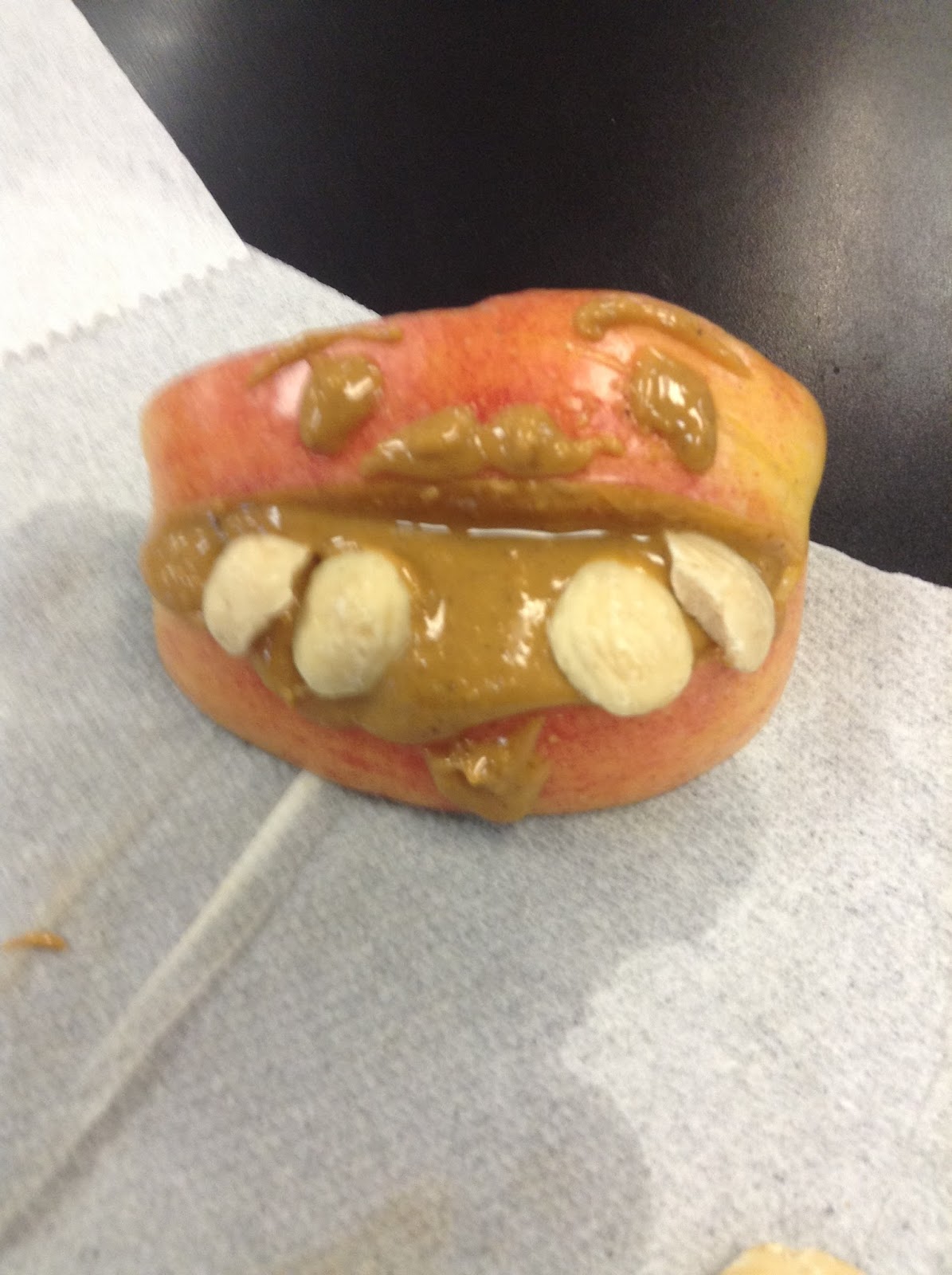
We made very cute and healthy snacks for Alexandria's and Simrun's Monday Wellness. We learned about what makes a healthy snack too. You should snack 2-3 times a day a couple hours before a meal and should eat nutrient rich snacks, not empty snacks that are high calorie and sugar.You should definitely stay away from super sweet and sticky snacks like artificial granola bars. Making the little apple snacks was really fun and were very yummy. The only thing is the apple got stuck in my braces but that has nothing to do with the activity.
His name is Reginald :)